Designing a Reliable Agentic Ingestion Pipeline (Part 2): Step-by-Step Checkpoints, Reasoning Token Budgets, and Pre-Persistence Gates
Production lessons: Step-by-step checkpoints and rerun_from recovery, preventing reasoning model token truncation, pre-persistence gates, and concurrency budgets.
In Part 1, I shared how we decoupled a complex unstructured financial podcast audio stream processing workflow using LangGraph to build a cooperative multi-agent topology.
However, running this system in production presented new engineering challenges:
- Long audio streams and multi-agent workflows involve significant API latency and financial cost. If a downstream node fails, do we really have to re-transcribe the entire audio file?
- When using reasoning models to refine insights, why do structured JSON outputs cut off mid-stream?
- When an LLM hallucinates or partially fails, how do we prevent incomplete placeholder data from corrupting historical production records?
In this post, I will dive into four key production solutions: Step-by-step Checkpoints, Reasoning Token Budget Management, Pre-Persistence Gates, and Concurrency Controls.
1. Step-by-Step Checkpoints and the Recoverable Data Factory
In earlier naive implementations, the pipeline persisted results only when all steps completed. But processing an episode involves downloading audio, STT transcription, multi-agent summarization, and social card rendering, taking several minutes.
If the pipeline failed at the very last stage due to a rendering error, re-running the entire job wasted minutes of latency and duplicated expensive transcription API calls.
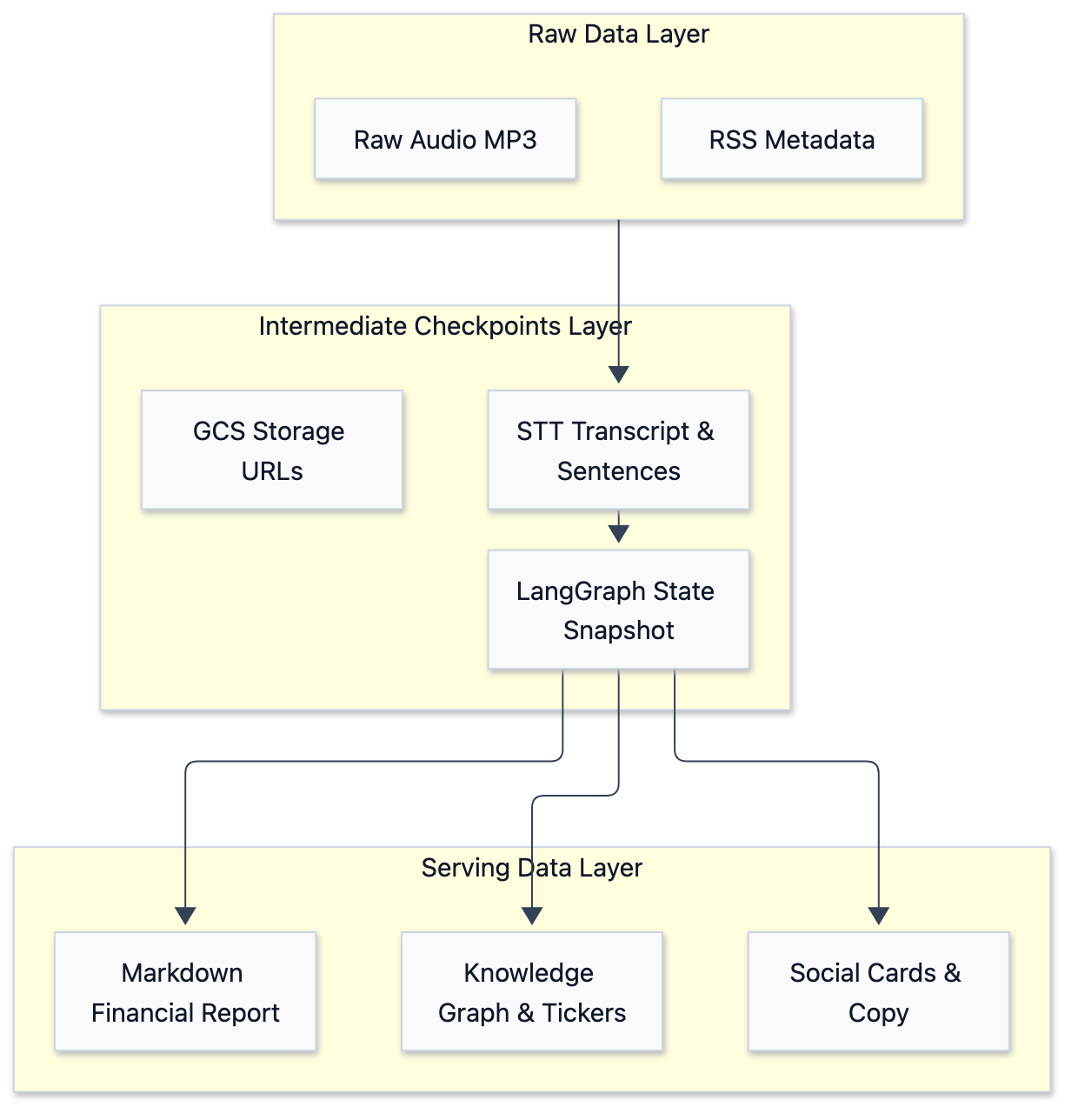
To build a truly resilient system, I structured the data layer into three distinct tiers:
Implementing rerun_from Recovery
At each major stage, intermediate state (downloaded audio, transcript sentence structures, storage URLs) is persisted immediately.
I introduced a rerun_from parameter. When a job fails down the line, operators or background retry tasks can specify a recovery starting point. For instance, setting rerun_from="summarize" loads existing transcript snapshots directly, bypassing audio downloads and STT transcription, and feeds the state straight into the LangGraph state graph.
This eliminates over 80% of retry latency and completely prevents duplicate transcription costs.
2. Model Selection and Reasoning Token Truncation
Model selection directly governs output quality and system stability. I evaluated several models using OpenRouter across multiple test runs:
| Metric | Reasoning Models (e.g. DeepSeek) | Fast Benchmark Models (e.g. Gemini Flash) |
|---|---|---|
| Summary Density & Structure | Compact with professional editorial tone. Accurately filters out chitchat and ads. | More verbose and literal. Tends to keep all small talk and Q&A clutter. |
| Tags & Ticker Accuracy | Moderate tag count, highly compliant with closed-vocabulary constraints. Precise ticker extraction. | Severe tag inflation, inventing invalid tags that fail validation gates. |
| Ticker Sentiment Extraction | Aligns paragraphs precisely into structured bullish/bearish arguments and risk factors. | Broad coverage but lower information density. |
Production Pitfall: Missing max_tokens Budget
While reasoning models won on summary quality and ticker precision, I ran into a severe production bug: For long episodes, structured JSON outputs frequently cut off mid-stream with Unterminated string errors.
Investigation revealed that reasoning models consume a vast amount of tokens on internal reasoning thoughts, severely squeezing the available max_tokens budget (e.g., 4096 tokens). When internal thinking takes up too much budget, the JSON output is forcefully truncated.
Fix: Disabling Reasoning Thoughts Explicitly
To resolve this, I explicitly disabled reasoning thoughts in API calls (passing extra_body={"reasoning": {"enabled": False}}).
As a result, the model no longer consumes budget on internal thinking tokens and allocates the full token budget to the structured JSON payload, eliminating mid-stream truncation errors entirely.
3. Pre-Persistence Gate (assert_summary_persistable)
When API calls fail or when an LLM hallucinates, extracted ticker lists can become inconsistent with the Markdown body (e.g. a ticker list containing AAPL while the summary text makes no mention of Apple). Persisting these errors overwrites historical good data.
I added a strict memory validation gate (assert_summary_persistable) before any database write:
- Reject Placeholders: Inspects outputs for any placeholder strings, blocking persistence if present.
- Ticker Mismatch Gate: Verifies that every ticker in
related_tickersappears explicitly in the Markdown summary body with proper formatting (#ticker:SYMBOL).
If any ticker in the list is missing from the main body, the system flags a Ticker Mismatch, throwing an exception and rejecting the database write to preserve data integrity.
4. Concurrency Budgets and Rate Limits
Multi-agent coordination fires multiple API calls per job. Processing multiple episodes concurrently easily triggers 429 Rate Limits from model providers.
I used Python asyncio.Semaphore to allocate independent concurrency budgets per stage:
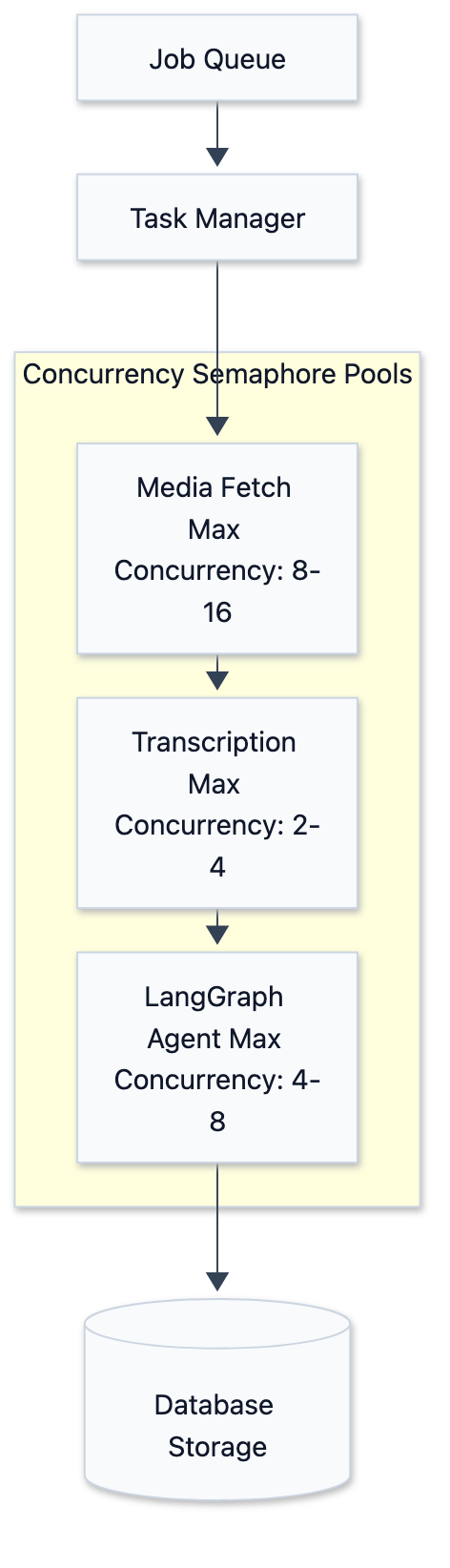
Decoupling concurrency budgets prevents cheap network fetches from blocking model calls, keeping parallel request volumes within safe thresholds.
Conclusion
Building a production-grade financial podcast ingestion pipeline is not about how powerful a single LLM is, but how well you engineer an unpredictable model call inside a predictable, recoverable software system.
Key lessons:
- Decouple into Multi-Agent Topologies: Use LangGraph to eliminate noise and truncation.
- Implement Step-by-Step Checkpoints: Preserve state snapshots to save time and API costs.
- Disable Reasoning Tokens: Prevent JSON truncation in reasoning models.
- Enforce Pre-Persistence Gates: Reject placeholders and ticker mismatches before database writes.
This architecture ensures our data pipeline consistently delivers high-quality financial knowledge graphs despite conversational noise.
Reference
- LangGraph Documentation: Build cyclic and branching multi-agent graphs.
- LangChain OpenAI Integration Guide: Configure ChatOpenAI and custom parameters.
- OpenRouter API Documentation: Understand model routing and rate limit handling.
- Python asyncio Documentation: Learn asyncio semaphores and task loops.